Physical Address
304 North Cardinal St.
Dorchester Center, MA 02124
Physical Address
304 North Cardinal St.
Dorchester Center, MA 02124

In 1687, Sir Isaac Newton published his Second Law of Motion, stating that “an object’s acceleration is dependent on the mass of the object and the net force acting on it.” Most commonly, we know this law as

where F is the applied force, m is the object’s mass, and a is its acceleration.
Interestingly, this same foundational principle applies directly to a seemingly disconnected field: management.
In business, a project’s velocity is the rate at which a team completes work over time. Its acceleration is the rate at which that velocity changes.
For example, if a team completes 10 tasks per week in Week 1 and 20 tasks per week in Week 2, their acceleration is 10 tasks/week².
Also, as a project progresses through its lifecycle, its mass increases exponentially. Early-stage projects are light — low cost, low risk, easy to pivot. But as you move toward commercialization, the stakes compound: design changes become expensive, testing becomes extensive, and the cost of failure skyrockets. The project becomes heavier.
So how does Newton’s Second Law apply to management?
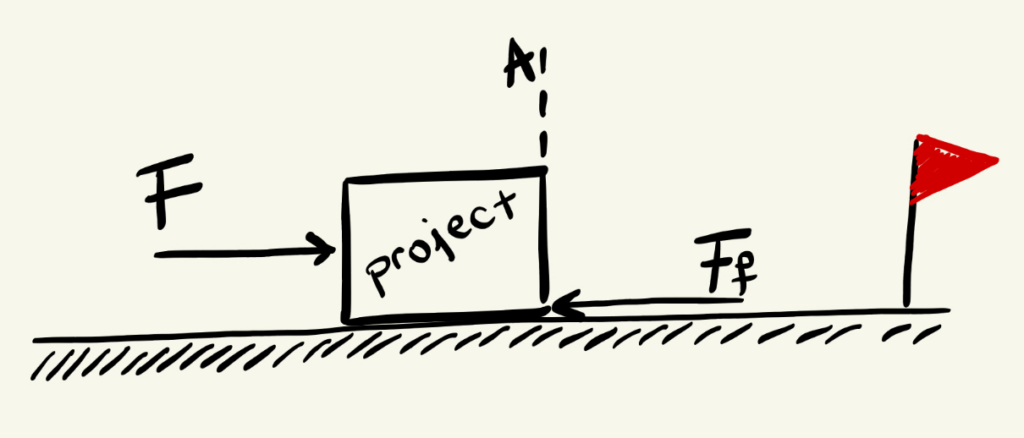
As captured in the diagram above, every company’s primary objective is to push a project from Point A to the finish line. However, this process is never frictionless. Your team’s applied force — funding, experienced technical leads, motivated team members — is constantly opposed by friction in the form of inefficient approval processes, unclear priorities, rework loops, and poor communication between stakeholders.
This scenario can be distilled to the following equation:
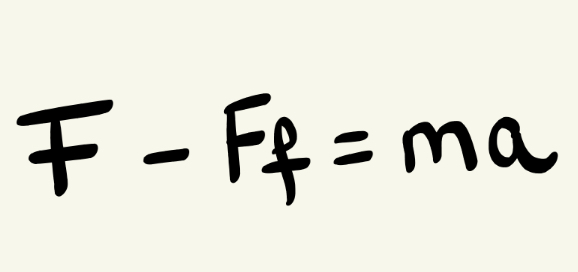
F = Applied force (funding, leadership, clear task prioritization)
Ff = Friction force (process inefficiency, ambiguity, rework cycles, poor communication)
m = Project mass (lifecycle stage, project value, cost of failure, cost of change)
a = Acceleration (rate of progress change)
Assume your project is in its final stages — design transfer, process validation, commercialization. At this point, the project’s mass is at its maximum. You’ve spent millions. Your customers’ anticipation of your product is at its peak. Any design change cascades through the entire system, taking longer to implement. The project is heavy.
Additionally, this is also when friction tends to spike. The quantity of deliverables increases. Cross-functional dependencies multiply. Available resources may not meet demand. If friction grows faster than your applied force, progress slows, or may grind to a halt — even when the finish line is in sight.
This is where a manager’s role becomes mission-critical:
Reduce friction and amplify force in anticipation of the project becoming heavy and vulnerable to stalling.
In practice, this is broken down into two parallel efforts.
Reducing friction:
Amplifying force:
Most projects don’t stall because teams lack talent or effort. They stall when systematic friction overwhelms a team’s applied force.
Newton gave us the equation in 1687. Now it’s on us to apply it.